Thursday, 11 October 2018

It's raining again...

Half way through our trip... only two more days to go!

It’s raining again – we happily sang along to the words of Supertramp at a concert 3 days after arriving in the UK for a British summer. As weather forecasts it was a bit wide of the mark, the driest summer in England since we were 15 years old, scarcely a drop of rain. What’s more it was pleasantly warm, with temperatures in the low 30’s.
It was only two months later as we flew into Chad that we encountered rain. It was not unexpected in Ndjamena as it is wet season in the Sahel, the life-giving annual rains that enable the millet to grow. As we flew in we saw that the usually flat brown landscape was green with large areas of flooding. Soon we would be travelling North across the Sahara  to Bardai and we wondered if Ruth and Rebecca who were travelling with us, might even experience a rare shower in the desert, just enough to to wash the dust of the windscreen.  
Setting off from N'djamena
At 6 am 6 days later we set off in a loaded pickup with our 2 Teda guides to cross the desert. All went well until we reached the end of the tarmac road at Massakory 3 hours north of Ndjamena. The sky was black and when the storm came it was impossible to see so we stopped the truck.  As the rain abated the road ahead resembled a huge lake and it was clear we couldn’t go on. A rapid decision was made to turn round, retrace our steps on the tarmac road  for an hour and go a little further north east and find a longer but drier route to head onwards to the desert and Moussouro. We all agreed we didn’t want to risk getting stuck in the mud.
Not at Massakore
The rain pounded down and it seemed like we had made a good decision to have turned around. After a couple of hours it was again time to leave the tarmac, we were in the right village Angora, but  had no idea where the other road /track was. It was only after a few false turns and some helpful Chadians that we wound our way amongst the houses and eventually on to the track to Moussouro. This was Chad as we had never seen  it before, green and lush and abounding in animals, herds of goats ,cows, sheep and camels all around.
A green and pleasant land


Not leaving Moussouro
With the delay we had thought we might need to spend the night at Mossouro and we had telephoned ahead to some missionary friends who live there. In the end we made good time but all the same took them up on an offer of coffee and cake and then drove on.Yet again the road had vanished what was normally a straightforward track towards the desert was invisible under the pools and even lakes of water.  We were getting seriously lost when we encountered a friendly local ambulance driver who offered to show us the way, taking us back to Mossouro and then going out of his way to make sure we were on the right route. 


Setting off in the middle of the night
When we stopped for the night it was late and it seemed it might rain again so a meal of bread and tuna fish was in order and then we camped out under the -no not stars this time but flashes of sheet lightening as the rain threatened again. By 3 am it came again and a rapid dash was made for the car and we drove on. We were entering the desert in driving rain splashing through pools of water until one was one too many and we were stuck in a mixture of mud and sand.

Stuck!

Thankfully by then it was only raining lightly again as all our bags were unloaded and digging started . After 3 hours and a lot of hard work we were out. The rain had stopped so we drove on a little then had a break for a meal (tuna again this time with pasta) and a well earned rest. We were now in the sandy desert amongst the dunes but even here there were pools of water.
Picnic after being stuck

Stuck again!
 After lunch as we drove on we came across other vehicles stuck in the sand, and we too were stuck again briefly. The rest of the day went well, including a stop at a well and a ‘service station’  for a coca cola and this time the rain stayed away and we arrived in the dry desert near to Faya camping just outside.

A well - good chance to fill up water bottles

Service Station
A tasty meal of tuna and pasta was good before falling asleep this time under the stars and staying in bed until 6 am luxury indeed.
Outside Faya

No shade..
We drove through Faya and felt we were heading for the real desert experience this time. The sky was blue and cloudless, the sun beat down and the sand dunes on the horizon were floating in the mirage. When we stopped to eat (tuna and spaghetti) our Teda guides even made a shelter for us with a tarpaulin as there were only a few tiny trees around.
We were close to the Tibesti mountains now and as we skirted around them it was no longer a mirage but even real desert rain and the Wadis were full of water after the rain on the mountains. The first looked like a large ford and we crossed without a problem .The next caused us to wonder if we were going to make it that day ,a car and a lorry were completely  stuck with a narrow gap between. Helpfully someone called us forward and whoosh we were through just enough space to spare and we didn’t slip!!

Squeezing through

Wading the Wadi
However there was still more to go and to our right was a huge storm cloud over the mountains which we seemed to be racing. The Wadi ahead looked shallow but to be sure our driver tested the depth and we crossed without a problem only to be completely blacked out by a dust storm which had caught us up. We had to struggle to find the higher ground and not stay in the dangerous Wadi bottom. As the rain came it washed away the dust and we could see our way at last. 

On towards Zoar K where the sight of cars half buried in sand just outside town showed us what force the Wadi can have when full. The cars were wrecked, hopefully everyone got out alright. Here at last was a respite from tuna and pasta and we had fried chicken, bread and a cold coke for tea at a local market restaurant, a very welcome change and then a nights sleep on the edge of town thankfully without rain.

Chicken not chuna
Our last day was up in the mountains without a drop of rain but the plants growing on the side of the road showed that even here it had rained.
Water in the mountains

Wadi at Bardai
Later that afternoon we drove into Bardai along the path of the Wadi which had also been full a few days before. We were on time just as expected despite all the rain and adventures. Four days and three nights under the stars, quite an experience which make us appreciate even more the alternative which we often use, a MAF flight.The six hour flight in a small plane albeit rather bumpy over the mountains that was scheduled for the return of Ruth and Rebecca in a months time, suddenly seemed very attractive to them.

...and a much quicker trip back
A month later...

The next afternoon as we were settling in what a surprise, It was raining again- this time a light shower leaving drops on the sand and a confusion as to where exactly we were, the fertile land of England or the barren and dry Sahara.

Thursday, 7 June 2018

Lessons from the market - Part 4


Lessons from the market -  part 4

‘Give us this day our daily bread’


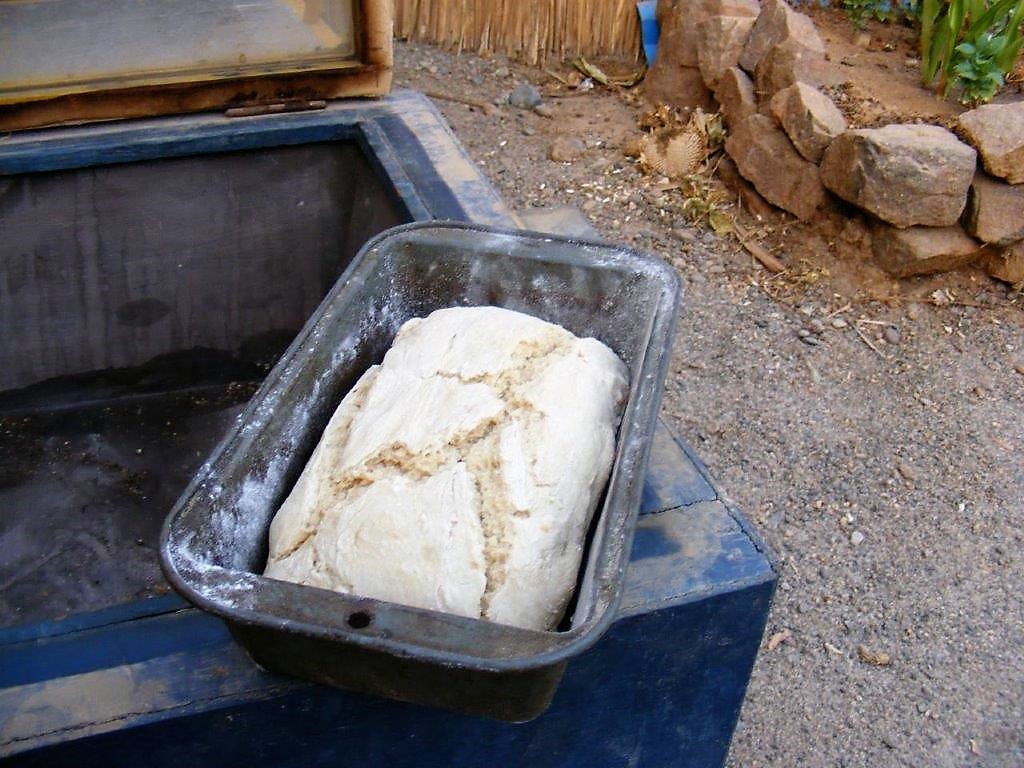
Fresh bread baked in our solar cooker
Whether that be a quiet prayer to God, or the cry of a hungry revolutionary mob demanding social justice, bread is seen as essential for life, either as blessing or as a right. It is an everyday staple in many parts of the world, and comes in many different forms. Some types are better for you than others, white flour fortified with iron, wholemeal, multigrain, sour dough are all beneficial in one way or another, but none, as far as I am aware is usually considered a harmful part of our diet. (Gluten-free bread is hopefully still available to those in need it as treatment on the NHS).


When we lived in Ndjamena we could get fresh baguettes each morning from the local lock up store. This is rather surprising as there is little or no grain grown in the French speaking parts of sub-Saharan Africa that I have visited, but in all of them, as a hangover from colonial times, subsidised flour is used to bake a standard priced baguette that is widely available. It presumably helps with social justice and the maintenance of a peaceful society. (Can all this really date back to the famous quote from Marie Antoinette and the hunger riots prior to the French revolution? I like to think so, but it is probably a convenient fiction)

At our home in Bardai, a mountainous mid Saharan oasis, you rarely see a baguette, but you may remember from a previous post that there is delicious local flat bread that the Teda women make using an oven of a simple half oil drum buried in the rocky hillside.

Teda bread being baked
What is really surprising is that until 20 years ago the people here used to grow their own wheat using the underground water from the wadi to irrigate the crop. They now use cheap white flour imported from Libya and many women make not only enough for their family but supplement their income by supplying bread to the growing number of shops and restaurants that are springing up due to the gold rush.

Bread is a daily staple, but can I ask how many days a week do you eat meat?
Every day? Twice a week? Never?
Some of you will be vegetarian, as are mountain gorillas, others will be meat eaters as are chimpanzees. Both are our close evolutionary relatives so what are we supposed to be?
I understood from school that it natural for us to eat meat as we have canine teeth to seize our prey and incisors to cut it, but they seem to work quite well on an apple so I don’t think we can argue either way based on our dentition.


A platter of special Ramadan food
Having a regular source of fresh meat in Bardai is something new. We mentioned frozen chickens last time, no doubt there always were a few chickens scratting around in the sand but never enough to sell. Red meat was even rarer, until last month when Ramadan began there was no meat stall on the market; it may well close at the end of the month.
Traditionally meat would be eaten after sacrifices at religious festivals or special events such after a birth, a death or a wedding. Knowing all of this last November, in preparation of our time in the north, and being carnivores seeking a balanced diet, we dried 8 kg of minced beef in Ndjamena. It looks like coffee granules, and we have been adding it a couple of times a week to our stews. It is fine but we have especially enjoyed the times that we have been invited to a wedding and had roasted camel.


Hay arriving from Libya
It is difficult to keep large herds here for even weekly meat, but the recent arrival of large trucks with hay again from Libya, to feed a growing number of goats, sheep and camels, suggests that, brought about by market forces, a change may be afoot. The power of gold is creating an increasing number of shack like restaurants, and they need meat to sell and not only chicken. Maybe I am wrong and the hay is normal and it is just enough to fatten the one sheep needed for every family to sacrifice at the Festival of Tabaski. (The Muslim commemoration of Abraham’s sacrifice of a ram in the place of his son on Mount Moriah Jerusalem.)

The world is changing, as it has done before.  The megafauna (elephants, rhino’s, and giraffes) along with herds of cattle carved into the rocks of the Tibesti at the time of the green Sahara, 5-10 000 years ago, attest to that.

Ancient rock carvings
 According to the British Medical Journal, in a commentary, (BMJ 2017;357: j2190) another great change has happened in the industrialised world over the last few generations. Instead of the estimated 5-10 kg of meat a year in ancient Greece and traditional European agricultural societies, our supermarkets now supply us with 10 times that amount, to the tune of 110-120kg a year (U.S.A/ Australia). Cheap meat is produced in large factory farms, using grain to fatten up corralled beef cattle. These are on the increase in the UK and have recently been in the news due to justified questions about animal welfare. The article in the BMJ points to even greater dangers. In a world of limited resources, it apparently takes up to 110 000 litres of water to make a kg of meat and fresh water is getting scarcer not only in the Sahara. In addition, a staggering 97% of global soy meal production is used as cattle feed, even though soya also tastes good as human food. We have mixed it 50/50 with our dried meat and as a consequence we still have 2 kilos of dried mince left after 7 months. In a world where protein energy malnutrition is common can we in all conscience use the worlds soy protein supply on the inefficient transformation of vegetable into animal protein simply because we prefer the taste of meat?

All of this is not necessarily new to you, and some have disputed the figures. A Swiss bio-farmer, grazing beef cattle on the mountainside, says he uses no outside water to make his beef as it all falls on his land and they eat only grass and forage from the farm.  A Guardian Data blog gave a more conservative estimate that on average 15000 litres of water is needed to make a kilogram of beef, which still sounds a lot to me. That is compared to chicken which uses a mere 4000 litres per kg. Soon a cry of

 ‘Four legs bad, two legs good,
Four legs bad, two wings good’

will be heard through the land. (apologies to George Orwell)

However, the BMJ commentary accompanied a piece of original peer reviewed research ‘Meat consumption and risk of mortality’ (BMJ/ 2017;357: j1957). The bottom line is that eating a diet rich in red and processed meats increased death rates due to heart attacks, diabetes, liver and kidney disease and cancer. So, it is not only the altruistic who should change their habits but also those with an enlightened self-interest.

The chimpanzee which I mentioned earlier as a meat eater is really only an occasional meat eater, if he could talk, he would probably call himself a flexitarian. Flexitarianism, which I only Iearnt about last year, is a mainly vegetarian diet with some meat. It could be seen as the latest faddy diet, but it seems to me that it is not the case; it is how we are really supposed to eat. Perhaps you, we and the Teda could all do well to resist the market change bought on by supermarkets and post WWII agricultural policy, or the gold rush, and help the planet by eating 10-20 kg of meat a year. That would be a big increase for the average Teda and a big decrease for the average westerner. It is something that we have been forced to do by circumstances, but not only that it seems like the right choice. Why not be part of a revolution as we say ‘pray with the world ‘

                                        ‘Give us all this day our daily bread’.

If that’s not for you, then at least in a spirit of self-interest, stick to chicken. It carries a lower personal risk than red meat and, as you know, it is the latest fashion in Bardai.

Saturday, 24 March 2018

Lessons from the market – part 3

The entrance to one of the restaurants on the main street, Bardai

Chicken is popular the world over and it makes a welcome addition to our diet at Bardai. It is not surprising to find them as, in Africa, a few chickens around the home are good as they eat scraps, lay the odd egg, and are ideal as gifts. The meat takes a bit of time to get used to, there is less of it   and it can be a bit tough, with prolonged boiling or pressure cooking needed to soften it up.

But the deep-fried chicken in Bardai is a bit of a surprise, all the chickens weigh about 1.2 kg in weight and are nice and plump.  It comes frozen from Brazil (yes really, I have seen the packaging). The chicken presumably is shipped across the Atlantic and into the Mediterranean, arriving at a port in Libya, Tripoli or Benghazi. It is then delivered by a refrigerated truck to a depot in Murzuk, a Teda town in southern Libya.  The last 600 km of the journey are the most interesting, a dash across the desert and through the mountains in a large domestic freezer strapped to the back of a Toyota pick-up truck. It takes about 14 hours and so they often set off at dusk and travel by night to avoid the heat of the day.
The chicken split down the breast bone is cooked in a large vat of oil heated on a wood fire, up to 10 at a time.  This is great from a food hygiene point of view as it is much easier to cook it through this way. It is then served with bread, salt, and some tomatoes and onions on a metal plate. It is not cheap costing 5000 CFA (£6.50) for a whole chicken but It is popular with the gold diggers who are in town for a break from their hard life on the gold fields and a monotonous diet of macaroni with tomato paste and tinned tuna. There are now four chicken restaurants in town and it is the presence of these mainly young men   that has made such business’ profitable. Men and women have very separate social lives in Bardai and the restaurants are very much a male preserve, and so sometimes I go and buy a take away on Sunday after church.  

Last month I had to go to a different restaurant as the one I had been to before had no chicken (They were serving omelettes but I can make those at home). They helpfully pointed out their competitor down the street. At the new restaurant, they were very friendly and even allowed me to take a few photos of the kitchen to go with this blog, I think I may well go back there, especially as they actually do have some chicken.

The supply chain is all important and if it fails the business is in trouble and customers are not satisfied as Kentucky Fried Chicken found out in the UK last month. At one time they had 420 of their 750 franchises shut due a lack of chicken.  Colonel Saunders had decided to cut costs and presumably increase profits by changing the company that distributed their frozen products to the fast food outlets. The supply chain completely failed making very unflattering headlines. Some people clearly thought it was a disaster prompting Tower Hamlets police to Tweet
Please do not contact us about the
 #KFCCrisis - it is not a police matter if your
 favourite eatery is not serving the menu
 that you desire
 Tower Hamlets MPS(@ MPSTowerHams)
 February 20, 2018.

It is however much more serious when a hospital runs out of essential medicines. You can imagine what happens when there is no insulin in Bardai as happened last December.  We are a long way from Ndjamena and the Central Pharmacy (CPA}, communication is not easy and, even there, stock levels there are sadly at an all-time low. At Guinebor we used to supplement the CPA supplies with purchases at private depots and pharmacies. The latter, situated opposite the Central hospital and medical school are well stocked albeit with rather expensive medicines and make lots of money as often the medicines prescribed in the hospitals are not available in the hospital pharmacy. In Bardai, we have less choice, there are just some common remedies for sale on the local market, many of dubious provenance.

Claire Bedford BMS pharmacist at Guinebor II has helped us out with an emergency stock of insulin and other essential drugs, including those to stop severe bleeding after childbirth to prevent a repeat of the earlier tragedy. She also supplied us with one 6-month treatment course for TB tablets for a newly diagnosed patient. The small package of medicines arrived in early January on a MAF flight and has been useful.

 Dr Abdul Kerim has just returned from his annual leave in Ndjamena and has managed to come with a year’s supply of TB and HIV drugs so we are making some progress. But as the hospital gets busier and attracts sicker patients the supply chain will have to improve. Small amounts of medicines from the Northern Regional depot in Faya and from Ndjamena will not be enough. We need a proper system of stock control, ordering and delivery.

There is already a supply chain for vaccines which is independent of the hospital structures. It’s a bit like the chickens, a dash up from Ndjamena with special cool boxes to maintain the supplies in good condition. The rest of the space in the vehicle could be used to send up drugs, it just requires some coordination, and organisation of the finances. Other avenues still need to be explored. Meanwhile Claire has made a brief visit to Bardai, using a spare place on the plane. She met our local pharmacist, it may be a fruitful relationship as they share experiences and contacts. Hopefully she will be able to help us out from time to time.

My brother Nick summed up the problem yesterday in a WhatsApp message
‘a chicken restaurant without chicken is not a chicken restaurant’

It may be obvious, like the emperor’s new clothes, but it needed saying and sorting out before it became an embarrassing problem.

And more importantly:
What of a hospital without drugs?
                                                    -----------------------------------------------

PS: One of the most spectacular improvements that has happened in my lifetime is the near eradication of polio from the African continent. I remember seeing acute polio a couple of times in Guinea in the early 1990’s and saw many more young children who came with paralysed legs requiring operations for contractures. The annual mass vaccination programs where all children under 5 years of age get doses of oral vaccine over a 3-day period in every, town and village each year have had a major impact in halting this disease.

It is a major distribution challenge, getting vaccines to places like Bardai and then having trained health workers, many local assistants, going from door to door. Most African countries including Chad have not had any confirmed cases in recent years. I think the last cases in Chad were due to refugee movements from war torn Northern Nigeria in 2014.  Vigilance is still required especially as most babies still do not access their routine childhood vaccinations and so the immunity of the population relies on these special campaigns.
A week after the rest of the country the campaign started in the Tibesti mountains, the vaccines had arrived late and also Dr Abdel Kerim had not been here to organise it.  Due to the dispersed population and lack of staff it took a week rather than the allotted 3 days. There was a modest ceremony at the hospital to start the campaign with the governor of the region giving a speech and vaccinating the first child and giving a dose of de-worming medicine. Various other dignitaries were called forward to give a dose of vaccine to a line of children many in their mother’s arms. Last of all I was called forward, and I didn’t immediately recognise the young child that had been set aside specially, it was Bardai Eli, the young baby with facial burns from last November. Even with the de-worming medicine smeared on his lips he does look amazingly better.

Sunday, 18 February 2018

Lessons from the market – part two

The market at Bardai consists of a street with lock up stores on it, they are roughly divided into food/hardware shops selling a curious mixture of tinned goods, rice milk and flour,pick axes, lightbulbs, simple electrics, buckets; and mens clothes/furnishing shops selling miscellaneous trousers, socks, shirts jalabeers, rugs, blankets and mattresses.

Of late rather smart heavy faux ‘camel skin’ coats from China have been in great demand. A must for the older man wanting to keep warm but look at the same well dressed. I have been wearing a jumper and T-shirt under my jalabeer a hidden addition which makes people think I am hardy and don’t need a coat. The market functions all day and on into the night.

There is a newer separate market where goods from Libya are sold from the back of pick up trucks. The number varies each day and they arrive with a variety of fresh goods, tomatoes, apples, bananas, oranges, potatoes, onions. Some days there are 5 or 6 others there are none, it just depends on the state of the frontier and the relative values of the Libyan dinar and the CFA (Central African Franc) They also sell the same tins and sacks as the main market, but this time in bulk. My adventures in bulk buying have not always been successful, I bought 25kg of flour, but the bread which Andrea made with it tasted of petrol, not a good buy.

Fresh eggs are a good part of our diet, but sometimes there are none to be found. If you find them on the smaller market they are sometimes hardboiled already (useful tip if language is difficult, check by spinning an egg on a tin, raw eggs don’t spin well, boiled ones spin like a stone. Also  remember that the last few eggs on a market stall are less likely to be fresh, so it is best to buy them in bulk as they arrive on the pick ups.) 

A few weeks ago, I came across a pick-up with a large carton of eggs all on trays of thirty. There was no queue and I asked to buy a tray but was surprised when the man said that they were expensive, 2500 CFA, so I should go to the next stall where they were cheaper at 2000 CFA. He had to say it twice as the first time it didn’t make sense to me. So I walked to the next stall, and waited in the queue, it was a bit of a wait. A Teda friend came up and so I asked him what it was all about, were these eggs not going to be fresh, where was the catch. He simply wants to be kind as his eggs cost more was the unexpected reply. 
I was still waiting after about 5 minutes and, typical westerner, beginning to think I would rather pay more for a quicker service. The man with the expensive eggs must have seen my frustration so he came over got me a tray of eggs took my money, gave it to the stall owner and then went back to his stall.  No doubt he sold his higher priced eggs later on in the day  when the other stall had sold out. An unusual way of doing business and really not what you would call a competitive  market rather it is a nice one  to visit.

So far the lessons from the market are quite simple and uncontroversial, smell flour for petrol, spin eggs to make sure they’re not already boiled and perhaps more usefully, take stall holders advice , they may actually be being nice to you. The next story, actually from a missionary cookbook, is a bit more provocative; it too is about buying a tray of eggs.

A US national working in Nigeria went to market, she was well versed in the local language and culture, and she observed the lady in front of her buy 3 eggs for 300 Naira. (sorry I don’t recall the exact figures but it is not important). She then asked for a tray of eggs and was asked for 4500 Naira. Quickly doing the maths she pointed out that her 30 eggs cost 150 Naira each whereas the other lady had only been charged 100 Naira per egg. So she asked whether the seller had made a mistake. No came the reply, anyone who can afford to buy a whole tray of eggs can afford to pay a bit more.

How do you feel about that? Was she really being ripped off? We in the west come from a culture where bulk buying saves money and  are more used to the idea of buy one get one half price offers. That is how free market capitalism is supposed to work, encouraging consumption,  usually to the advantage of the rich. 
Let's look at an everyday example of how the market works in the UK.
Your electricity and gas is cheaper if you can afford to pay on contract a regular monthly sum through out the year. If you are less well off and pay what you use each quarter it is more expensive per unit used.  Most expensive are the meters that require payment tokens to make the system work. I noticed that when we moved into our home in Wakefield in 2005 and being rich, quickly got that changed. So in essence the more money you have available to pay bills the cheaper they are. It seems right or at least normal doesn’t it? Although perhaps a bit unfair?

(Now in the following examples I am using idealised figures as living in Bardai I don’t have access to either gas or electricity to get  current prices, but the principle behind the figures is a reality in Chad)
In Chad if you buy a small 8 kg bottle of gas it will cost say 4000 CFA, if you buy a 15 kg bottle it costs 10 000 CFA, which makes the bigger bottle more expensive for each kilo of gas. The logic is that the government want to encourage people to buy gas for small hob burners, decreasing the use of firewood and charcoal, and also helping the poorer people in society. The larger bottles are good for gas cookers, fridges and water heaters so you pay more for the gas, it is after all use with for luxury items.

The electricity bill is structured in the same unusual way, the first 20 kw each month are at a cheaper rate than the next 30 kw and then more expensive again after 50 KW. It’s a graduated system in the same way as income tax.  The poor person who struggles to pay the bill for an electric light is helped and the rich pay more for their air conditioning. Seems a fair deal to me.

Finally the same is true of water bills, so effectively the main 3 utilities are subsidised.
I can imagine the outcry in the UK if any one of the political parties proposed such a change, it would be a scandalous meddling in the near sacred ‘free market’. I guess it would be, but that doesn’t stop it being a good idea. Perhaps we can learn an economic lesson from Chad, (yes really- the west can’t be right all the time can it?) Cheaper water, electricity, gas and public transport for the less well off.
The idea is utopian, but it is not new.  I do seem to remember that in the temple at Jerusalem there was a graduated scheme for an offering to ask God for forgiveness, a young bull for the high priest, a male goat for a leader, a female goat for a common person, two doves or pigeons for a poor person, or one and a half kilos of the finest flour for a very poor person. Perhaps that form of ‘progressive pricing’ for essential  is a lesson that we need to rediscover.

Sadly it is more likely that in the future that external forces perhaps the World Bank or IMF will insist that Chad implements market reforms, in return for a financial relief package to cushion the economy against the effects of the lower oil price. In other countries this has meant privatisation of state assets, removal of subsidies on foodstuffs and fuel and a free competitive market, for whose benefit? 
-Something to think about.

Tuesday, 23 January 2018

Lessons from the market- part one

Football, a  world wide frachise. Sign outside a video club in Bardai, about 60p a match, same as a can of Coca Cola
Last Saturday at about 5 pm with the sun setting behind the mountains there was a light breeze which made the 18C air temperature feel a bit cool. Last chance for a wash and a shave towards the end of a busy day, visiting patients, pulling teeth and helping Andrea do the washing by hand.  The solar cooker had some nice warm water so whilst Andrea cooked tea I showered and at the same time listened to the football on BBC short wave. (we are one hour ahead of GMT so it was the second half)

‘and there’s a  goal in the Championship, 10 man Leeds have levelled  Leeds United 2 -  Millwall 2’’

A few minutes later

‘’ and another goal at Elland Road, what a fight back by Leeds in front of their home crowd, it’s      Leeds 3 Millwall 2’’

And then Andrea called me for tea, reception is not great so I heard no more, you have to catch the score as the goals go in as they only read the final scores for the Premiership, Bundersleague, Serie A and La Liga. It is after all the World service. Our 2G phone signal can download simple emails and Whats app text messages but we can’t surf the net for news, hence the need for the wireless.
Later I spoke to my Mum and Dad on the phone, they said they would send me the result if I could send them my email address (they’ve just got reconnected after technical difficulties). 
The connection wasn’t good and I don’t think my message got through. So next day passing Whats app  messages  with our daughters, Ruth and Rebecca, they let me know the final score

 Leeds united 3 – Millwall 4

Sadly eleven players against ten usually wins. (I presume that Leeds didn’t lose another player!)  The difference between the sides a man, which makes, as far as I can see, a player worth 3 points.
Footballers are of course worth a lot more than that, they are worth real money. I remember in 1980 seeing Justin Fashenu of Norwich scoring the goal of the season, a volley from about the half way line that beat the Liverpool goal keeper, next year he was sold to Nottingham Forest as the first one million pound player. A few years later, in 2000,  I saw Rio Ferdinand presented as a new signing at Elland Road for a record £18 million fee. This was in the days before Leeds financial meltdown. The market decides how much players are worth, and our ascendant neo liberal economic model encourages  free markets. ‘’ In God we trust’’ but are we trusting Yahweh or the golden calf?                                           

Last weekend Arsenal and  Manchester United  finally made a realistic evaluation of the true  value of a player.  How much is a player worth? Answer: one player. You have to admire the logic. After all these years of ever inflating prices, a transfer that cost no money, they simply swapped players. (I am choosing to use the BBC headline and ignore the fact that there was still the agents fees to calculate on the deal, which apparently will not be an insignificant sum, not sure how they can do the sum I always thought 5% of zero was zero) So one man is worth one man, a brief outbreak of sanity in a mad market place.

Of course, instead of hard currency as is usual or bartering as above, they could have done the deal using Bitcoin instead.  But then the player might loose 50% of his value in a month even without breaking his leg.  Perhaps something old fashioned and tangible like  gold would be more sensible way of measuring worth. A typical premiership  footballer is worth ten times his  weight in gold, 25 million pounds. A golden calf has to make more sense than the idea of a golden calf in computer code.
A small local gold nugget worth about £200


So how does this blog have anything to do with Chad, besides the short wave radio and dodgy internet connections? I mentioned gold in the paragraph above, personally I can think of nothing that I would less like to invest in right now, bar the international arms trade.  Bardai is changing, the centuries old traditions of subsistence farming, (dates, wheat and market gardens) and trade in salt through camel trains have been largely replaced by gold mining and now Toyotas traffic market goods across the desert. The market is booming, the town is growing and people are richer than ever before but the human cost is high.

How much is one gold digger worth? Not much, life is harsh, brutal and cheap. Of 4 gold diggers in hospital at the moment, (they are the only hospitalised patients at the moment), one broke both legs in a rock fall that killed his friend, one was shot in in the leg when an argument was settled with an AK-47, and one was deliberately burnt on the legs to get information on a theft: only the last one has a normal everyday medical problem.

The world markets are thirsty for gold,  as an investment in uncertain times,  for jewellery and no doubt some for manufacturing useful electronic devices.  It has to come from somewhere but at what cost?

It seems to me that for every person that benefits and is happy someone else has to pay and suffer. On the whole the rich get richer and the poor…………………?  Is that how markets are supposed to work? In the next post I will have some interesting, somewhat surprising examples from Chad, which can teach us all some positive ways of doing business. You may think them odd and impractical, but in reality football transfer fees and Bitcoin probably make less sense and we all seem to get along with them as ideas.

Match at Bardai, can you spot the next George Weah?