Wednesday, 2 January 2019

A Tale of Two Cities.


 That may not seem a very seasonal choice of Dickens titles, to which I am obliged to reply, ‘bah humbug’ and carry on regardless. So ‘A Tale of Two Cities.’


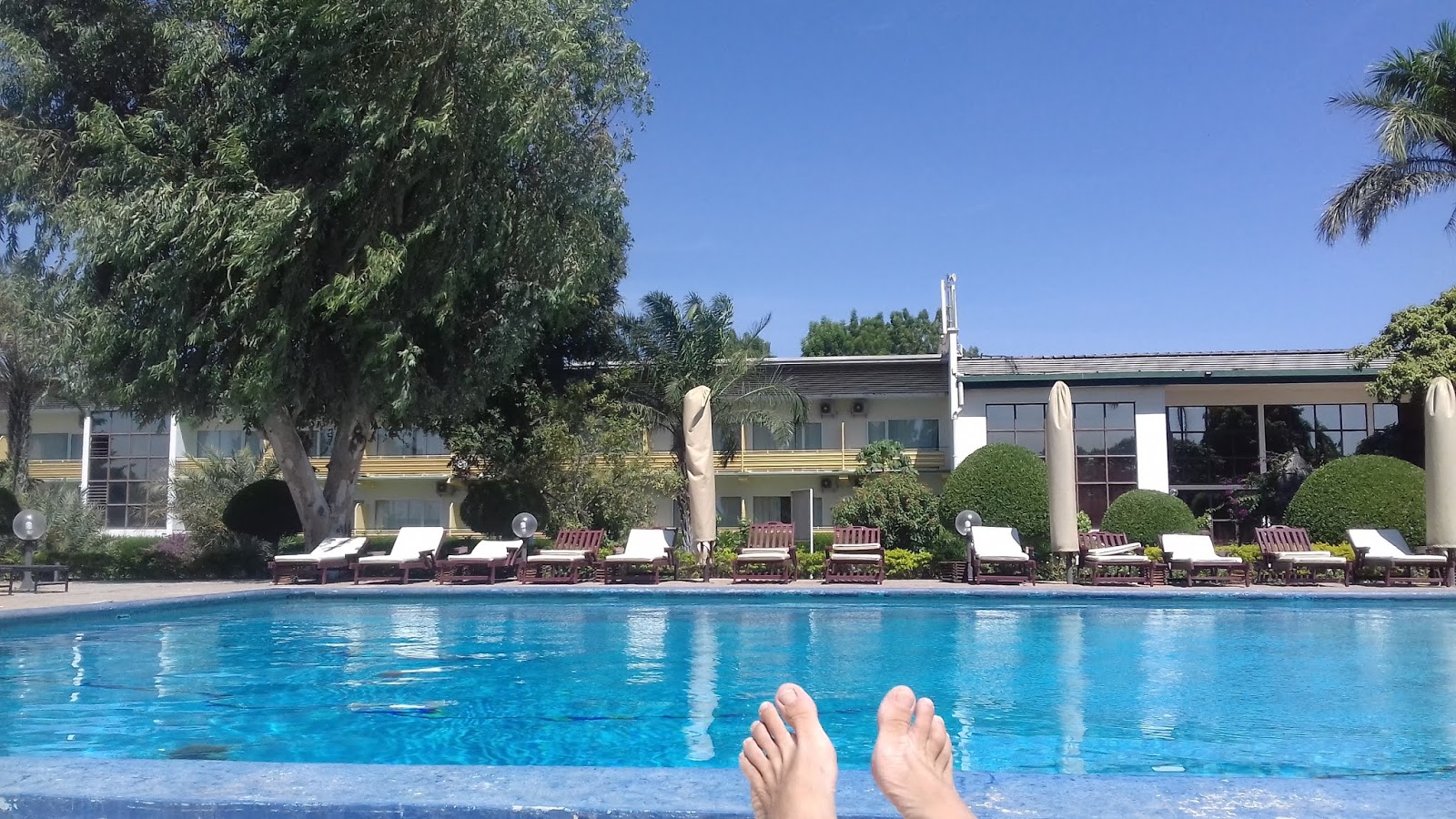
The first 'city' is really a hotel, it is as big as a village and exudes importance. Built in the style of a Roman palace it has a defensive wall, and huge gates with armed guards. Situated by the river it makes an impressive sight, and all the trappings of worldly splendour have been added, huge tastefully furnished entrance lobbies, an amazing swimming pool and gardens. See for yourself by clicking here 

The vast conference/ballroom can seat 500 at tables, has chandeliers, air conditioning, and offers a very fine selection of coffee and vienoisserie mid-morning, plus sumptuous buffet lunches from what are no doubt excellent kitchens. All this was less impressive than the very interesting well organised meeting organised by the Ministry of Health over 4 days in mid- December. It was a bit of a surprise to get a telephone call from the Regional Health Director in the Tibesti whilst driving in a rather battered looking yellow taxi to the Health Ministry building. The line was very poor, but I eventually understood I was to go to the Hilton straight away and represent him at the meeting. Once there I saw that a major theme was Maternal Mortality and so Andrea joined me the second battered taxi of the day to grace the otherwise impeccable fleet of 4X4 and limousines on the forecourt.
It was really a very informative set of meetings, with presentations and debates amongst the participants from the 23 regions of Chad, all the major hospitals, the various programs and agencies, malaria, TB, HIV, UNICEF, WHO, etc. The second day, having been directed to our seats amongst the Chadian Regional Health Directors, and feeling a bit conspicuous, someone spotted us and assuming that we were with a large NGO, thought we should be on the other side of the room, but then agreed we  were already in the right place.
In addition to the main theme, Important subjects such as rural health mutual assurance, the currently bankrupt national Central Pharmacy warehouse, immunisation programs and the National budget were discussed. Perhaps the most important for us was how to encourage government employees who are deployed to places such as Bardai to actually go to their postings rather than simply remaining in Ndjamena and drawing their centrally paid salary. It seems there may be a move towards decentralisation which may help.
 As well as gaining a better understanding of the health care system in Chad we renewed and made a number of new contacts, and even had a brief talk with the health minister, who had some words of encouragement for our work in Bardai.
We sensed that there was a genuine attempt to address the major problems and can only hope that in a years time we can hear of targets for immunisation being reached, more doctors and nurses working in the regions and a revitalised Central Pharmacy supplying low cost, good quality, generic drugs throughout the country.

Two days later just before Christmas we had a completely different experience, a journey from the centre of Chad to the margins took us to Teriturenne, a village about 8 hours drive north of Ndjamena. The second half of the route is across the same area of Sahel that had proved impassable due to rain at the start of our journey last August. Now it was bone dry and it was difficult to believe that the large herds of cattle and other animals that we saw will be able to survive until the next rains; passing from water hole to waterhole and eating the meagre ration of spontaneously dried hay that thinly covers the area. The rolling hills of sand and earth have scattered trees with occasional villages on the higher ground.

 It is said that ‘A city on a hill cannot be hidden’ but if the houses are spaced out single room mud brick buildings without electricity it can be very difficult to spot, especially as we arrived at Teriturenne after night fall. There are about 60 homes in the 2 halves of the village. Light is not the only thing that is lacking. The name of the village Teriturenne means ‘one water pail village’ and that water supply is 1-2 km away down a steep sandy hill to the low ground, where the water is close to the surface. Despite this there is a thriving school in the local language that is attracting about 150 young people and children from the surrounding area. This is a new concept to learn to read in Dazaga and then teach French later. The same project is now working to get a solar powered well into the heart of the village, and as we arrived a team of experienced Chadians were working to drill a well by hand 60m deep. It was night and they had been drilling since midday and they continued working by the lights of one of our vehicles. The bore was completed and lined with a plastic tube by midnight. It was a real community event with women gathered round , ululating and garlanding the most enthusiastic worker; three men rode up on horseback and pranced back and forth and then rode off with gusto. The joy was palpable and the next day the news on everybody’s’ lips was ‘the well was born’.On the next trips the water tower will be erected, and the solar water pump installed.

We were there to see whether there was any possibility of having a small health clinic in the same village. We spent most of the day travelling over 100 km around the local area looking at what clinics were already in place. Fortunately, we had talked with the Chief Medical officer for the region at the Hilton Hotel just 3 days before to get his permission for the visit. We were travelling with a Chadian who is now a teacher in the University having done a master’s in law in the UK and who is seeking to help his birth village.

Recurring themes in all the villages we visited were the lack of drugs in the clinics, the problem of getting women having difficulty in labour to hospital, absentee staff, and a total lack of even basic dental care. They seemed less concerned about the lack of a good complete vaccination program and seemed proud and content with the once a year anti polio campaign.

In the evening we learnt about the reality of rural healthcare, there may well be a small clinic about 10 km away,but there were two patients who were seriously unwell and had been for 2 or 3 days, and no one was making any effort to get help. (apart from asking the visiting doctors after dark). The first was a man who was severely dehydrated with a diarrhoeal illness and another a young girl with a severe infection of the face and a high fever. We had an emergency kit with us and were able to set up the necessary intravenous drugs in their homes, something which we never do elsewhere, but it was clearly a day to bend the rules. The young girl was improving by the next morning and after a second injection could continue with tablets. The man needed more care in a hospital or clinic, but refused to travel, so on our way home to Ndjamena we stopped off at the clinic 10 km away and spoke with the local informally trained nurse. We paid for the necessary medicines and he agreed to go and give them. He knows the village as his son is there staying with friends so that he can go to the school. We have since heard that both have done well. Later this month we can check on them when we go back to speak again with the local people, do some health education and treat any dental problems that are there.

And now a question to consider; in which city would you expect to see God at work, at the Hilton or in Teriturenne? The answer we are glad to say is that we have seen it in both. However, if you are wise enough to be looking for a baby, try the village, the stars are truly amazing.

Friday, 14 December 2018

Waiting for Christmas


So here we are still in Ndjamena and not yet sure when we will return to Bardai, we are praying for a peaceful resolution to the conflict the start of which caused us to come to Ndjamena 6 weeks ago. It’s a strange feeling because being in Ndjamena, which was previously our normal Chadian place to be: It suddenly seems a special and luxurious place almost half way to being in England!
So in true Christmas celebratory spirit lets tell you about the 12 days of fun.

No1.Watching Hippos by the river
We spent a week in a new missionary retreat centre by the river and while we there not only did we see lots of beautiful birds and sunsets but a family of Hippos too. They announced their arrival very loudly the night we arrived and their departure the night before we left.

No 2. Having the chance to go to a wedding.
We had heard that Yola one of the nurses at Guinebor was getting married and were wondering how to send her a gift. Well we were not only able to do that but to be at her wedding too it was fun to be there with the other staff from Guinebor and celebrate with her.

No 3. Being at the Team conference.
We spent a great week being taught more about Jesus our shepherd and how to follow him and hearing how others are doing that all around Chad. We also had fun together visiting the farm we used to go to with Ruth and Rebeca horse riding for a barbeque amongst other things .Including Mark wearing a Manchester United outfit(very stressful) as there were no others available at the market and we had to dress up in something representing our country.

No 4. Going Swimming.
A relaxing day was spent at the pool with only 3 colleagues to share the 25m pool for most of the day. Mark finally managed to achieve a target that he set about 5 years ago with Ruth and Rebecca, to swim the same number of lengths as your age. (They had the advantage of youth) .

No 5. Having a washing machine.
Actually this is more than one day you’ll be glad to hear, but it’s very nice not to do our own washing by hand.

No 6. Eating out.
We have been out a few times notably for Thanksgiving where half of us were Americans but also recently to have a sandwich in N'djamena’s latest newly decorated café where you can eat in a taxi bus.


No7. Having (even book) shops to visit.
From the same café come bacon and ice cream, delicious treats not available in Bardai. Except for the one time when we turned our solar fridge into a freezer and it valiantly fought outside temperatures of 44C to make ice cream at -14C, a staggering 58C difference inside and out. We have also been to a bookshop and managed to buy some great medical books to take back to Bardai.

No 8. Having language lessons.
Well it’s not exactly a treat but it is good to have the time to do this without other demands on us and we have found a teacher who is really patient and helping us to progress.

No 9. Going to the theatre.
We were hearing about Rebecca's theatre trips in London and thinking how nice that would be- now since being here we have been to one guitar concert. a play about child soldiers and some modern dance. All at the French cultural centre in town in an outside theatre, it has been a real pleasure.


No 10. Having Whats app and internet in the house.
Its lovely to be in more frequent contact with our family and we are really enjoying this but trying not to get too used to it.

No 11. Not being freezing cold.
Actually at first we were a bit warm but now temperatures have dropped to a cool 33C by day and 15C at night. It’s certainly easier than wrapping up every night and sleeping under layers of blankets, Bardai is 4C overnight. However we know what we would really prefer.

No 12. A Christmas craft market
This year there seem to be several of these. Last Sunday afternoon we went to the Hilton an experience in itself! An opulent 21st century version of a large Roman villa. They had a craft fair including a stall from the Acacia project that Rebecca worked with and a huge tree and lots of decorations. There will be another with products from around Chad at the French cultural centre later in the month and yet another at another hotel later on. There are Christmas carols playing in the supermarket too.

This year we are going to enjoy celebrating here in Ndjamena with an English carol service by candle light and Chadian church celebrations. Although we would have equally if not more have enjoyed this in Bardai and actually the mincemeat and Christmas pudding are still there. Not to mention our presents and decorations. Despite this the Grinch hasn’t stopped Christmas coming. We like you will be celebrating the birth of JESUS.

We have a ‘tree’ and are using it as a reverse advent calendar putting on one decoration a day. I am going to try and make acake and homemade mince-meat so we’ll see how that works. I’ll be lucky if it’s as good as my solar cooker cake last year


 We pray that you like us will be able to celebrate and know the presence of the Prince of Peace this Christmas where-ever you are.


Wednesday, 14 November 2018

After the War - Lest we forget.


Armistice Day, 11/11/1918, was rightly commemorated last weekend around the world. At last, after four years of terrible industrialised fighting and unprecedented death and destruction, the war to end wars was over. 
An old weapon, the underground tunnelled mine had been perfected and was used with devastating effect at Messines Ridge in 1917 when 19 nearly simultaneous explosions of a massive 455 tonnes of explosives killed an estimated 10,000 German soldiers. (ref 1). But as the war drew to a close, these traditional mines were being replaced by the new much smaller, at first improvised and then factory made, landmines. These were placed in the ground to defend against the new chariots of war, trench busting tanks. They have become an indispensable part of the military arsenal.


In the late 1960’s and 70’s our family made an annual visit to my aunt and uncles farm at Burgh le Marsh. We visited nearby Skegness and played on the beach for days on end. I have many happy memories but a couple of things fascinated me, the faint memories of WW2. A small number of ex-army landing craft which rolled along the beach giving rides to fun loving tourists, and a disarmed sea mine acting as a collection box to help shipwrecked sailors. Old military equipment being put to a better use, memories of a distant war. But it was only 25 years since the end of WWII, the beaches at and around Skegness had been part of the 1,997 minefields laid around the UK in 1940 (ref 2). In total about 350,000 mines were laid to prevent an invasion, and then removed, often with considerable difficulty and cost in human life. Around Britain accidents happened through the 1950’s with residual munitions, I don’t recall hearing of any in my lifetime, certainly they weren’t frequent. However, whilst writing this I found that in a controlled explosion an old anti-tank mine was destroyed at Gibraltar Point not far from Skegness in 2015 (ref 3). The de-miners had done a good, brave, but imperfect job. 

Driving into the Tibesti on a white stone lined road


As we entered the Tibesti from Zoar-Ke last year we saw a destroyed tank and other vehicles from another past war, the Libyan- Chad war of the 1980’s. We also saw the white stones by the roadside which mark areas of potential minefields. It was all from some conflict some 30 years before and yet as we entered Bardai there were zones either side of the road which were unsafe to drive on. It all seemed a little unreal, but we asked questions and were told that as long as we stayed on the roads we were reassured that we would be fine, that there were no mines in Bardai itself, and there were many less accidents than there had been a few years ago. The local demining team was still active and once in a while there was a controlled explosion of collected anti-tank mines. The people in danger we were told, were incoming goldminers who didn’t believe the local Teda when they said that a zone was dangerous.

A controlled exposion in the Tibesti -MAG


The task of demining the Tibesti is more difficult than the beaches in the UK. MAG have worked here since 2004 (ref 4). The British minefields had been marked and surrounded by barbed wire and other defences so as to avoid accidental entry to the minefields. The mines were laid above the tide line and in many cases the mines were wired together to facilitate eventual removal and prevent migration. I don’t know how the minefields in the Tibesti were marked, but mines in wadis get washed downstream when the dry river beds flood, and through years of rebellion and civil unrest mines have been lifted from their original sites and used to booby trap roads. For these there are no reference charts. Naturally the roads, dirt tracks, have been swept for mines, but nothing is static.

One day we went to a neighbouring village for a wedding, there were many pickups parked by the mosque. Our Teda friend parked as neatly as possible to save space but was told to go no further forward as there was a mine buried, in a small area marked by white stones, right in the middle of the village. An hour or so later, on leaving, our vehicle was hemmed in, and so a man stood in the circle told us to drive forward over it, there’s nothing here he said. We decided to wait all the same, best not to take a risk. Is there really a mine there, who knows, apart from the man who laid it.

A short while later there was an explosion on a well travelled road to another village, just up the wadi from Bardai. A large lorry heading to market with many passengers on top had set off an anti-tank mine. Thankfully only the tyre was blown off, perhaps the mine had sunk deep into the sand. A fortunate escape, but all the same there was an impressive hole. A colleague of mine from the hospital lives about 200m off the road at that point on a small rocky hill. He doesn’t have a car but rides a motorbike.


So how common are landmine accidents around the world? The Nobel Peace Prize winning International Campaign to Ban Landmines collates statistics from each country and publishes The landmine and cluster munitions monitor. (ref4). These and following statistics for Chad come from their 2017 report.

Around the world in 2016 there was an increase in the number of incidents related to mines and discarded munitions with 8605 casualties, at least 2089 were fatal. Most casualties were civilians (78%) and 1544 (42%) of those were children. These are the highest figures since the Mine Ban treaty of 1999 which bans the laying of mines that are activated by human contact (antipersonnel mines) but not yet those activated by vehicles.


There have been 3011 casualties recorded in Chad by the Landmines and Cluster Munitions Monitor with 1179 deaths. Recently a decreasing trend has been apparent with 27 casualties in 2016, with no reported deaths. Thirteen were caused by mines and 12 by old shells etc and in 2 cases it was not declared.


In the last 6 months these numbers on a graph have become real to me. Twice I have been called to the hospital to treat young men who have been in a pick-up truck that ran over a mine whilst off road out of town. They both died of multiple blast injuries. Whilst I was in the UK in the summer another two people died in another couple of incidents. In the first a young man who took a different route into town because of the flooded wadi, and in the second the wife of a friend of the ADP was killed. She had been at a busy meeting place under a tree on the edge of a local village and was killed as she was driven away.  All of these were local Teda people and all caused by anti-tank mines laid over 30 years ago, but which can still be laid under the Ottawa Protocol.

A fifth young casualty was a gold miner. He was at work when he came across something unusual, a plastic canister that he didn’t recognise. It was an antipersonnel mine. These are designed to maim and not kill as the injured require help from colleagues further depleting an attacking force. It blew up in his left hand. He arrived at the hospital the next day after a long drive with improvised bandages over both of his hands, he looked terrible. Once he was stabilised we operated the same day, amputating the remains of his left hand at the wrist, and cleaning up his badly injured right hand plus all the other shrapnel wounds and flash burns to his chest arms and legs. He was cared for by his friends who had to feed and wash him every day. I was amazed that how cheerful the young victim was as I visited him. He was it seems simply glad to have survived and to be receiving treatment. What more he was going to get a functional right hand. After 2 more trips to the operating theatre and finally skin grafts to his thumb and fingers he was able to hold a spoon and feed himself. He left the hospital exactly one month later returning to his home town in the east of Chad.


A young man who doesn’t smile for photos

These five families and many more like them will never have the possibility of forgetting the danger of landmines.


  1. World War I underground: unearthing the hidden tunnel war. Peter Jackson. BBC News . Magazine 10 June 2011
  2. Evans, Roly (2017) “World War II Coastal Minefields in the United Kingdom” Journal of Conventional Weapons Destruction Vol 21 Iss 1 Article 9
  3. Anti tank bomb explodes at Gibraltar point- Skegness Standard .Facebook Jan 14 2015
  4. w.w.w.maginternational.org/what-we-do/where-we-work/chad/
  5. Landmine Monitor www.the-monitor.org

Thursday, 11 October 2018

It's raining again...

Half way through our trip... only two more days to go!

It’s raining again – we happily sang along to the words of Supertramp at a concert 3 days after arriving in the UK for a British summer. As weather forecasts it was a bit wide of the mark, the driest summer in England since we were 15 years old, scarcely a drop of rain. What’s more it was pleasantly warm, with temperatures in the low 30’s.
It was only two months later as we flew into Chad that we encountered rain. It was not unexpected in Ndjamena as it is wet season in the Sahel, the life-giving annual rains that enable the millet to grow. As we flew in we saw that the usually flat brown landscape was green with large areas of flooding. Soon we would be travelling North across the Sahara  to Bardai and we wondered if Ruth and Rebecca who were travelling with us, might even experience a rare shower in the desert, just enough to to wash the dust of the windscreen.  
Setting off from N'djamena
At 6 am 6 days later we set off in a loaded pickup with our 2 Teda guides to cross the desert. All went well until we reached the end of the tarmac road at Massakory 3 hours north of Ndjamena. The sky was black and when the storm came it was impossible to see so we stopped the truck.  As the rain abated the road ahead resembled a huge lake and it was clear we couldn’t go on. A rapid decision was made to turn round, retrace our steps on the tarmac road  for an hour and go a little further north east and find a longer but drier route to head onwards to the desert and Moussouro. We all agreed we didn’t want to risk getting stuck in the mud.
Not at Massakore
The rain pounded down and it seemed like we had made a good decision to have turned around. After a couple of hours it was again time to leave the tarmac, we were in the right village Angora, but  had no idea where the other road /track was. It was only after a few false turns and some helpful Chadians that we wound our way amongst the houses and eventually on to the track to Moussouro. This was Chad as we had never seen  it before, green and lush and abounding in animals, herds of goats ,cows, sheep and camels all around.
A green and pleasant land


Not leaving Moussouro
With the delay we had thought we might need to spend the night at Mossouro and we had telephoned ahead to some missionary friends who live there. In the end we made good time but all the same took them up on an offer of coffee and cake and then drove on.Yet again the road had vanished what was normally a straightforward track towards the desert was invisible under the pools and even lakes of water.  We were getting seriously lost when we encountered a friendly local ambulance driver who offered to show us the way, taking us back to Mossouro and then going out of his way to make sure we were on the right route. 


Setting off in the middle of the night
When we stopped for the night it was late and it seemed it might rain again so a meal of bread and tuna fish was in order and then we camped out under the -no not stars this time but flashes of sheet lightening as the rain threatened again. By 3 am it came again and a rapid dash was made for the car and we drove on. We were entering the desert in driving rain splashing through pools of water until one was one too many and we were stuck in a mixture of mud and sand.

Stuck!

Thankfully by then it was only raining lightly again as all our bags were unloaded and digging started . After 3 hours and a lot of hard work we were out. The rain had stopped so we drove on a little then had a break for a meal (tuna again this time with pasta) and a well earned rest. We were now in the sandy desert amongst the dunes but even here there were pools of water.
Picnic after being stuck

Stuck again!
 After lunch as we drove on we came across other vehicles stuck in the sand, and we too were stuck again briefly. The rest of the day went well, including a stop at a well and a ‘service station’  for a coca cola and this time the rain stayed away and we arrived in the dry desert near to Faya camping just outside.

A well - good chance to fill up water bottles

Service Station
A tasty meal of tuna and pasta was good before falling asleep this time under the stars and staying in bed until 6 am luxury indeed.
Outside Faya

No shade..
We drove through Faya and felt we were heading for the real desert experience this time. The sky was blue and cloudless, the sun beat down and the sand dunes on the horizon were floating in the mirage. When we stopped to eat (tuna and spaghetti) our Teda guides even made a shelter for us with a tarpaulin as there were only a few tiny trees around.
We were close to the Tibesti mountains now and as we skirted around them it was no longer a mirage but even real desert rain and the Wadis were full of water after the rain on the mountains. The first looked like a large ford and we crossed without a problem .The next caused us to wonder if we were going to make it that day ,a car and a lorry were completely  stuck with a narrow gap between. Helpfully someone called us forward and whoosh we were through just enough space to spare and we didn’t slip!!

Squeezing through

Wading the Wadi
However there was still more to go and to our right was a huge storm cloud over the mountains which we seemed to be racing. The Wadi ahead looked shallow but to be sure our driver tested the depth and we crossed without a problem only to be completely blacked out by a dust storm which had caught us up. We had to struggle to find the higher ground and not stay in the dangerous Wadi bottom. As the rain came it washed away the dust and we could see our way at last. 

On towards Zoar K where the sight of cars half buried in sand just outside town showed us what force the Wadi can have when full. The cars were wrecked, hopefully everyone got out alright. Here at last was a respite from tuna and pasta and we had fried chicken, bread and a cold coke for tea at a local market restaurant, a very welcome change and then a nights sleep on the edge of town thankfully without rain.

Chicken not chuna
Our last day was up in the mountains without a drop of rain but the plants growing on the side of the road showed that even here it had rained.
Water in the mountains

Wadi at Bardai
Later that afternoon we drove into Bardai along the path of the Wadi which had also been full a few days before. We were on time just as expected despite all the rain and adventures. Four days and three nights under the stars, quite an experience which make us appreciate even more the alternative which we often use, a MAF flight.The six hour flight in a small plane albeit rather bumpy over the mountains that was scheduled for the return of Ruth and Rebecca in a months time, suddenly seemed very attractive to them.

...and a much quicker trip back
A month later...

The next afternoon as we were settling in what a surprise, It was raining again- this time a light shower leaving drops on the sand and a confusion as to where exactly we were, the fertile land of England or the barren and dry Sahara.